

How to choose a travel passport holder
of reading
At the airport, you quickly realize: a poorly protected passport gets damaged, bent, scratched, or disappears at the bottom of a bag at the worst possible moment. If you're wondering how to choose a travel passport holder, the right approach isn't just to look at the style. A good case must primarily protect, remain practical to use, and adapt to your way of traveling.
The choice seems simple, but in reality, there are several criteria that truly change the comfort of use. Between compact formats, models with storage, flexible or rigid materials, and security options, everything depends on the type of traveler you are. The goal is not to choose the prettiest case in a photo, but the cover that prevents wear and tear and saves you time daily.
How to choose a travel passport holder according to your needs
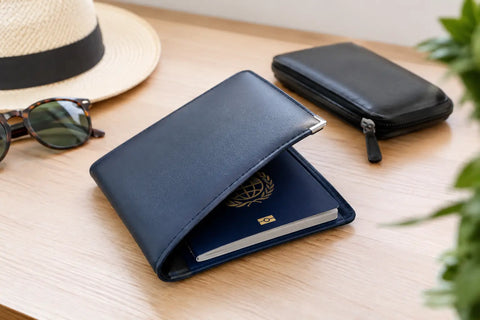
The first question to ask is very concrete: what exactly do you want to protect? If you only carry your passport, a thin and light case is often sufficient. It prevents dog-eared corners, protects the cover, and makes the document easier to spot in a bag or an inner pocket.
However, if you travel with a printed boarding pass, bank cards, ID cards, permits, or tickets, a travel passport holder with multiple compartments becomes more useful. You gather the essentials in one place, which limits stressful handling at the check-in counter or security check.
You also need to consider the frequency of use. For occasional travel, a simple model does the job very well. For regular trips, it's better to aim for a more durable cover, with neat stitching, reliable closure, and a material resistant to friction. After constantly being taken in and out of a bag, a low-end case quickly shows its limits.
The right format makes more of a difference than you think
A case that is too tight makes it difficult to insert the passport and can mark its cover. A model that is too large takes up space and gives an impression of disorganization. The right format is one that holds the passport without compressing it, while allowing quick access.
For many travelers, the classic vertical format remains the most practical. It respects the shape of the passport and slides easily into a bag pocket or a small pouch. Wider, wallet-style formats are better suited for those who want to centralize several documents.
There's a real trade-off here. The more storage a case offers, the more useful it becomes for organization. But the more comprehensive it is, the thicker it can become. If you like to travel light, it's better to avoid models that promise to contain everything, at the risk of becoming bulky.
Compact case or multi-functional model?
The compact model is very suitable for short stays, city trips, and travelers who keep their other documents elsewhere. It protects the essentials without adding bulk.
The multi-functional model is more suitable for long journeys, family trips, or travel with multiple proofs of identity. It provides real peace of mind, especially when several documents need to be shown in a short amount of time. The right choice therefore depends less on the product itself than on your travel routine.
Material: aesthetic, but above all, protective
The material influences the lifespan of the case, its feel, and its ease of maintenance. This is a crucial point if you are looking for a cover that provides durable protection.
Synthetic materials have a simple advantage: they are highly resistant to friction and easy to clean. For everyday use, this is often the most practical choice. A small stain or a trace of moisture is easier to remove than on some more delicate materials.
Leather-effect models are popular for their more refined appearance. They are perfect if you want a sober, elegant, and versatile case. However, depending on the finish, they may require a little more attention to maintain a beautiful appearance over time.
Fabric cases are often lightweight and pleasant to the touch. They can be interesting for a more casual style, but you need to check the material's durability and the quality of the seams. A fabric that is too thin will provide less protection against folds and abrasion.
If you're hesitating, ask yourself a simple question: is your priority the visual appearance or ease of use? In most cases, the best choice remains a flexible but resistant material that protects without adding bulk.
Security: useful, but not at the expense of practicality
When talking about travel passport holders, security often comes up first. This is logical, but one must not confuse real security with gadget options.
A button, zipper, or flap closure can be reassuring, especially if you also store cards or cash. It prevents papers from slipping out when you open your bag. But if the closure slows down every manipulation, it quickly becomes cumbersome during security checks.
Some travelers also look for RFID protection. For many, this is an interesting bonus, especially for frequent travel or in very busy places. It's not essential for everyone, but it can enhance the feeling of security. As often, everything depends on your usage and your level of caution.
The most important point often remains the simplest: a visible, well-organized, and easily identifiable case reduces the risk of loss. An overly discreet model in a large bag can be less practical than a cover that is easily noticeable at a glance.
How to choose a travel passport holder without neglecting comfort
A good case isn't just about protection. It should also make travel smoother. This is where seemingly minor details make a difference.
The passport should be able to slide out easily, without forcing it. Compartments should not be too narrow. If you travel often, you'll also appreciate a coating that doesn't stick to your fingers, an intuitive opening, and a structure flexible enough to be handled quickly.
Weight also matters. On paper, a few grams seem negligible. In real use, a lightweight accessory is more pleasant, especially when it already accompanies a phone, wallet, charger, and other essentials. The idea is to protect without adding another constraint.
Finally, comfort also involves internal legibility. A well-designed case allows you to quickly see what it contains. When everything is stacked or tightly packed, you waste time and increase the risk of forgetting a document after checking.
Style and color: yes, but with common sense
Style has its place, of course. A travel passport holder is one of those accessories you keep for a long time and handle often. So, it's normal to want a model you like.
That said, the prettiest model isn't always the most practical. Very light colors can show marks more quickly. Very rigid finishes can be elegant, but sometimes less pleasant to use daily. Conversely, a simple, understated, and well-designed model often proves to be the most cost-effective in the long run.
The right approach is to choose a cover that matches your actual use. If you travel for work, a discreet and clean design is generally the most versatile. For personal travel, you can opt for a more colorful model, which is easier to spot in a bag. This small detail avoids many unnecessary searches.
Common mistakes when buying
The first mistake is to choose solely based on price. A very cheap case can be a temporary solution, but if it quickly deforms, doesn't open properly, or poorly protects the edges of the passport, you'll have to replace it quickly. The right purchase is one that lasts over time.
The second mistake is to overestimate your needs. Many people buy a large model with multiple compartments, then only use the main slot. The result: an accessory that is more cumbersome than necessary. A suitable cover is better than an overloaded product.
The third mistake is to ignore the quality of the finish. The seams, the hold of the corners, the flexibility of the material, and the regularity of the closure already give a good idea of durability. Even online, these elements deserve your attention.
At a specialist in covers like 1001 Housses, the advantage is precisely being able to compare styles, formats, and uses within the same product universe. This helps to quickly choose a protection consistent with your actual need, without getting lost in overly broad categories.
The best travel passport holder is the one you use easily
Ultimately, choosing well means finding a balance. There needs to be enough protection to prevent wear and tear, enough practicality to keep your documents accessible, and enough simplicity so that the case doesn't become a burden. A compact, durable, and well-designed model is often enough to make all the difference.
Before buying, imagine your next security check: you open your bag, grab your case, and effortlessly pull out your passport. If this scene seems simple with the chosen model, you've probably found the right cover.