

How to protect your car from hail
of reading
A cracked windshield and hail-damaged bodywork can happen in minutes. If you're wondering how to protect your car from hail without turning every weather alert into a headache, there are simple, effective, and above all, realistic solutions for everyday use.
Hail is a real problem because it strikes quickly, sometimes without leaving time to react. And unlike simple rain, it can leave lasting damage on the hood, roof, trunk, mirrors, and windows. The right approach is not just to look for protection at the last minute, but to anticipate with a solution adapted to your parking situation, your budget, and the frequency of storms in your region.
How to protect your car from hail daily
The best protection remains a closed shelter. A garage protects the bodywork, windows, and exterior accessories without any particular effort once the car is parked. If you have this option, it's clearly the simplest and most reliable solution.
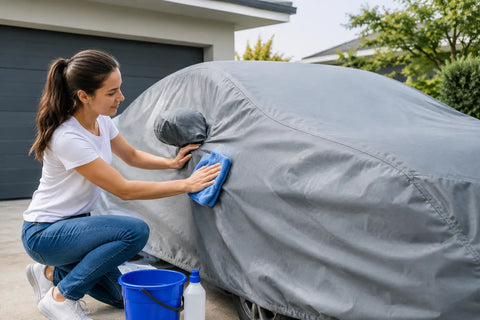
But many motorists have neither a garage nor covered parking. In this case, a car cover adapted to bad weather becomes a very useful option. However, it's important to distinguish between a simple dust cover and a cover designed for outdoor use. For hail, a classic, too-thin cover is not always sufficient. It's better to choose an outdoor cover with a thicker material, good wind resistance, and, if possible, reinforced areas on the most exposed parts like the roof, hood, and trunk.
The advantage of a cover is twofold. It acts as a first barrier against light to moderate impacts and also protects the car from rain, leaves, sun, and dirt. For a driver who often parks outside, it's practical protection on several fronts, not just against hail.
Is a car cover really effective against hail?
Yes, but we must be honest about its limitations. A protective cover can reduce damage, especially during small to medium intensity episodes. It cushions the shock and limits superficial marks. However, during a violent storm with large hailstones, no soft cover promises total invulnerability.
This is where many people go wrong. They think that protection is either perfect or useless. In reality, between a car left exposed to the storm and a car covered with a well-fitted outdoor cover, the difference can be significant. Fewer impacts, fewer scratches, and lower costs afterward.
The key point is the fit. A cover that's too large floats, moves, and offers less protection. A cover that's too small doesn't cover certain areas well. A good cover conforms to the shape of the vehicle, stays securely in place, and covers sensitive elements without leaving too much room for wind.
What to look for before buying a cover
To protect a car from hail, the material matters a lot. A multi-layer material is generally more reassuring than a very lightweight fabric. You also need to check its water resistance, as storms often combine heavy rain and hail. A waterproof but breathable cover is preferable to prevent moisture from being trapped for too long.
The fastening system is just as important. Well-placed straps or elastic bands help keep the cover in place when the wind picks up. Without them, even good material loses effectiveness. Finally, the size must match the type of vehicle—city car, sedan, SUV, or longer car.
At a cover specialist like 1001 Housses, the advantage is precisely being able to look for protection according to actual use, not just according to color or price. For a vehicle exposed outdoors, this detail makes a big difference.
What to do if you don't have a garage?
When you don't have a fixed shelter, you need to think in terms of quick backup solutions. First, identify covered areas near your home or work. A covered parking lot, a service station, a sturdy awning, or a temporarily rented storage unit can make a difference on days with weather alerts.
Then, keep your cover in the trunk if the risk of storms is frequent. This is a very practical and often overlooked point. Protection left at home is useless when the weather turns during office hours or in a supermarket parking lot.
Some people use cardboard, thick blankets, or mats to improvise a barrier. In extreme emergencies, this can help, but it's neither stable nor truly suitable. If the wind blows, these protections move quickly. And if they retain water, they can even become troublesome. A real car cover is simpler to put on, cleaner, and more consistent for repeated use.
Where to park when a storm approaches?
If you know a hailstorm is coming, the choice of parking spot becomes as important as the cover itself. Covered parking remains the safest option. If you can't find one, look for a spot protected by a stable structure. You should avoid trees, even if the shade seems reassuring. A branch broken by the wind can cause more damage than the hail itself.
Also, beware of fragile shelters or lightweight structures. A poorly fixed simple roof or a garden gazebo doesn't always protect properly. The ideal is a solid, stable, and wide enough covering to avoid side projections.
If you absolutely must leave the car outside, put the cover on correctly and quickly, then make sure it is well secured. A poorly fastened cover that blows away at the first gust of wind loses all its purpose.
Common mistakes when trying to protect your car
The first mistake is waiting for the first hailstones to look for a solution. By then, it's often too late. Effective protection is chosen before storm season, when you have time to compare sizes and materials.
The second mistake is thinking that a basic, universal cover will always do the job. For occasional indoor use, perhaps. For a car parked outside in an exposed area, it's better to aim for an outdoor cover designed for bad weather. Price is not the only criterion. Fit, thickness, and ease of installation are just as important.
Third mistake: putting a cover on a dirty car. Dust or small debris trapped between the car and the fabric can promote micro-scratches when the cover moves. A clean or at least dusted car limits this risk.
Finally, many forget the frequency factor. If you have to install and remove the cover often, simplicity becomes essential. A too complicated protection often ends up in the closet. It's better to have a practical cover that you actually use than a very technical model that you never install.
How to protect your car from hail depending on your situation
It all depends on your parking situation. If your car sleeps in a garage, you already have the essentials. In this case, the question arises mainly during trips, at work, or when traveling. A foldable cover in the trunk can suffice as complementary security.
If you park outside every day, the logic changes. You need regular protection, easy to install, and resistant enough to stay in place despite wind and rain. A suitable outdoor cover then becomes a real everyday essential, just like a sunshade in summer or a de-icer in winter.
And if you live in an area where hailstorms are rare but sometimes violent, the good compromise is often a ready-to-use cover and a simple habit: monitoring weather alerts. This is not a matter of paranoia, just common sense. A few minutes of anticipation can avoid much more costly repairs.
After the storm, should anything be checked?
Yes. Even if the car seems intact, take a few minutes to inspect the roof, hood, trunk, and windows. Small impacts are sometimes better seen in glancing light. Also check the mirrors and windshield edges.
If you used a cover, let it dry properly before folding it, especially if it got wet from the rain. This helps keep the cover clean, durable, and ready for the next alert. Well-maintained protection protects better over time.
Protecting your car from hail is not about finding a miracle solution. It's about choosing an appropriate cover, knowing your parking options, and adopting a few simple reflexes before the sky darkens. When the weather becomes unpredictable, the best protection is often the one you already have at hand.